- 31 October 26
DV360 API Deprecates Key Brand-Safety Exclusions, Forcing Programmatic Workflow Revisions
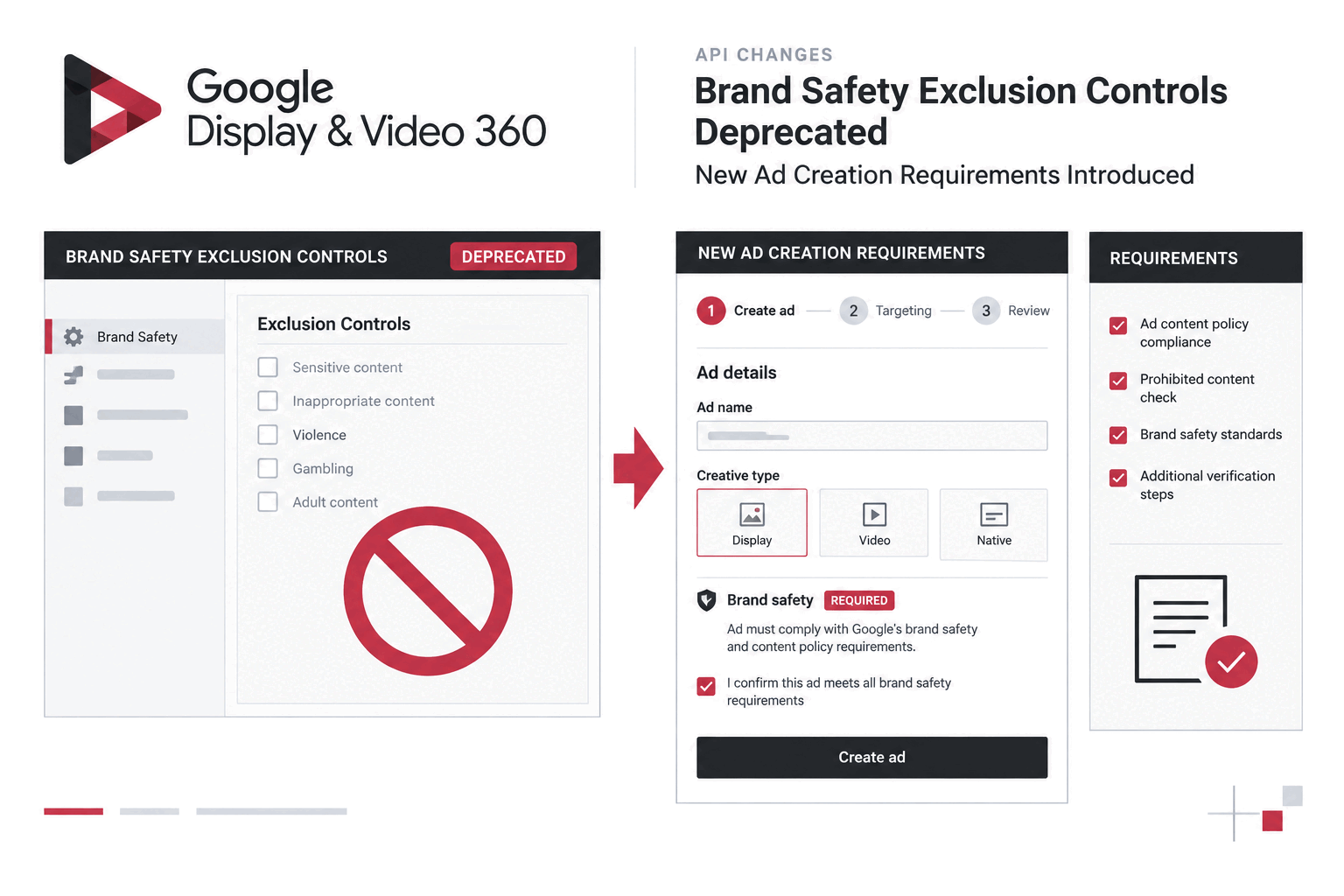
Programmatic buying teams using Google Display & Video 360 are preparing for a significant infrastructure change after Google confirmed upcoming deprecations affecting brand-safety targeting controls in the DV360 API and Structured Data Files (SDF). The update removes support for specific digital-content-label exclusions and most sensitive-category exclusions, impacting automated campaign-management systems, bidding frameworks and bulk-deployment workflows. [https://ads-developers.googleblog.com/2026/08/october-2026-changes-to-display-video.html] [https://support.google.com/displayvideo/announcements/9210754?hl=en]
Central Technical Change
According to Google's developer documentation, integrations relying on TARGETING_TYPE_DIGITAL_CONTENT_LABEL_EXCLUSION and TARGETING_TYPE_SENSITIVE_CATEGORY_EXCLUSION will lose access to many currently supported exclusion values. The change affects both direct API implementations and SDF-based campaign automation stacks frequently used by agencies, trading desks and programmatic infrastructure providers. [https://ads-developers.googleblog.com/2026/08/october-2026-changes-to-display-video.html]
Impact On Automated Buying Systems
The operational concern is not campaign creation itself but validation logic embedded inside internal deployment tools. Many programmatic teams maintain custom scripts that automatically apply predefined suitability templates across thousands of line items. Following the deprecation, unsupported values may require removal from configuration libraries, validation layers and automated trafficking pipelines. Because the modification is classified as an unversioned change, existing integrations may be affected without waiting for a future API-version migration. [https://ads-developers.googleblog.com/2026/08/october-2026-changes-to-display-video.html] [https://searchengineland.com/google-announces-october-changes-to-display-video-360-api-486175]
Community And Practitioner Signals
Discussion among ad-operations and programmatic practitioners has focused on the reduction of granular exclusion controls and the necessity of reviewing existing brand-safety frameworks before enforcement dates arrive. Operators managing regulated verticals, gambling campaigns and reputation-sensitive brands appear particularly focused on auditing legacy exclusion templates embedded inside trafficking systems and programmatic deployment scripts. While Google has announced replacement suitability mechanisms in parallel DV360 workflows, practitioners are evaluating whether those controls provide equivalent operational granularity. [https://support.google.com/displayvideo/announcements/9210754?hl=en] [https://searchengineland.com/google-announces-october-changes-to-display-video-360-api-486175]
Additional API Requirement
The same update cycle introduces a new requirement affecting YouTube responsive-ad creation. Developers will be required to provide a business name and logo during ad creation or update procedures when advertiser-level defaults are unavailable. This affects API-driven ad generation and SDF upload environments commonly used by large-scale programmatic operations. [https://ads-developers.googleblog.com/2026/08/october-2026-changes-to-display-video.html]
Operational Checklist
- — Audit all templates using digital-content-label exclusions.
- — Review sensitive-category exclusion logic inside automation pipelines.
- — Validate SDF import/export workflows against upcoming field restrictions.
- — Check YouTube responsive-ad generators for mandatory business identity assets.
- — Test deployment scripts before enforcement deadlines reach production environments.
Sources
[https://ads-developers.googleblog.com/2026/08/october-2026-changes-to-display-video.html]
[https://support.google.com/displayvideo/announcements/9210754?hl=en]
[https://searchengineland.com/google-announces-october-changes-to-display-video-360-api-486175]
Latest Blog