- 10 October 26
Multilogin 12.15 Introduces Proxy Auto-Refresh Logic and Social Identity Changes for Anti-Detect Operations
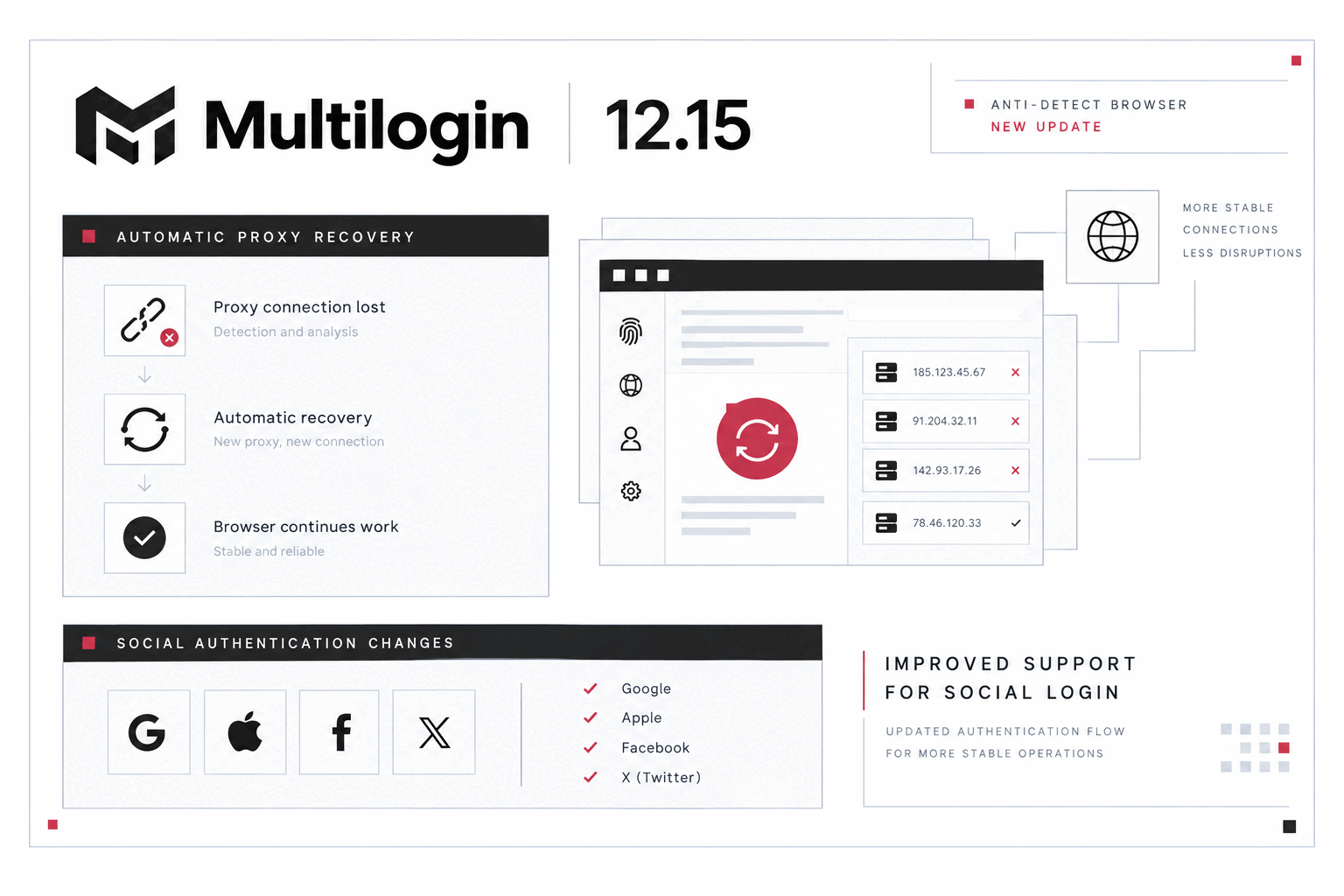
Multilogin released version 12.15 with a set of operational changes that directly affect anti-detect browser workflows, proxy stability management, account access procedures, and team-level security policies. While the release contains several usability updates, the most practically relevant change for traffic operators is the new proxy recovery mechanism that automatically retries profile launches after obtaining a fresh proxy IP when the initial validation attempt fails. Sources: [https://multilogin.com/release-notes/]
What Changed
The update introduces automatic proxy remediation during profile startup. According to the vendor, when a proxy verification fails, Multilogin can refresh the assigned IP and perform an additional launch attempt automatically. The release also fixes validation behavior for custom proxies that recently received new IP assignments, reducing cases where otherwise functional proxy endpoints were incorrectly rejected during launch checks. Sources: [https://multilogin.com/release-notes/]
In parallel, the platform added social sign-in support through providers such as Google and Apple. This change alters the authentication model because users authenticating through social identity providers now manage two-factor authentication through those providers rather than through Multilogin itself. Backup codes previously used for built-in 2FA are no longer part of the authentication workflow. Sources: [https://multilogin.com/release-notes/]
Operational Impact for Media Buying Teams
For affiliate teams running large profile fleets, failed proxy checks are a recurring source of launch interruptions, particularly when rotating residential infrastructure changes exit IPs shortly before session initialization. The new retry logic does not eliminate proxy quality issues, but it reduces the amount of manual intervention required when failures are caused by temporary IP-state inconsistencies rather than permanent connectivity problems.
- — Lower probability of profile launch interruptions caused by recently rotated proxy IPs.
- — Reduced manual restart activity during high-volume account management operations.
- — More predictable behavior for teams using dynamically refreshed proxy pools.
- — Additional attention required for workspace-wide 2FA policies because social-authenticated users follow a different security flow.
Community Signals
Discussion signals observed across anti-detect and affiliate communities during the first days following the release focused primarily on proxy handling improvements rather than the new login options. Operators managing large account inventories highlighted proxy validation as a more immediate bottleneck than interface changes. Early reactions suggest that automatic proxy refresh and re-check behavior is viewed as a workflow optimization rather than a feature expansion.
No public technical explanation was provided regarding the underlying root cause of the earlier proxy validation edge cases. The vendor confirmed the behavioral change but did not disclose implementation details of the new recovery sequence. Sources: [https://multilogin.com/release-notes/]
Why It Matters
The update should be viewed as an infrastructure reliability release rather than a feature-heavy expansion. For arbitrage teams, media buyers, account farmers, and automation operators, launch stability often has greater operational value than new browser fingerprint controls. The introduction of automatic proxy recovery changes an important failure point in daily anti-detect operations and may reduce downtime associated with rotating proxy environments. Sources: [https://multilogin.com/release-notes/]
Latest Blog